

Μυτιληναίος: Υπεγράφη η σύμβαση για την κατασκευή του πρώτου Logistics Park στην Ελλάδα
7 Ιανουαρίου 2019
Best City Awards 2018: Ασημένιο βραβείο στην κατηγορία “Green City” απέσπασε ο Δήμος Λαρισαίων
8 Ιανουαρίου 2019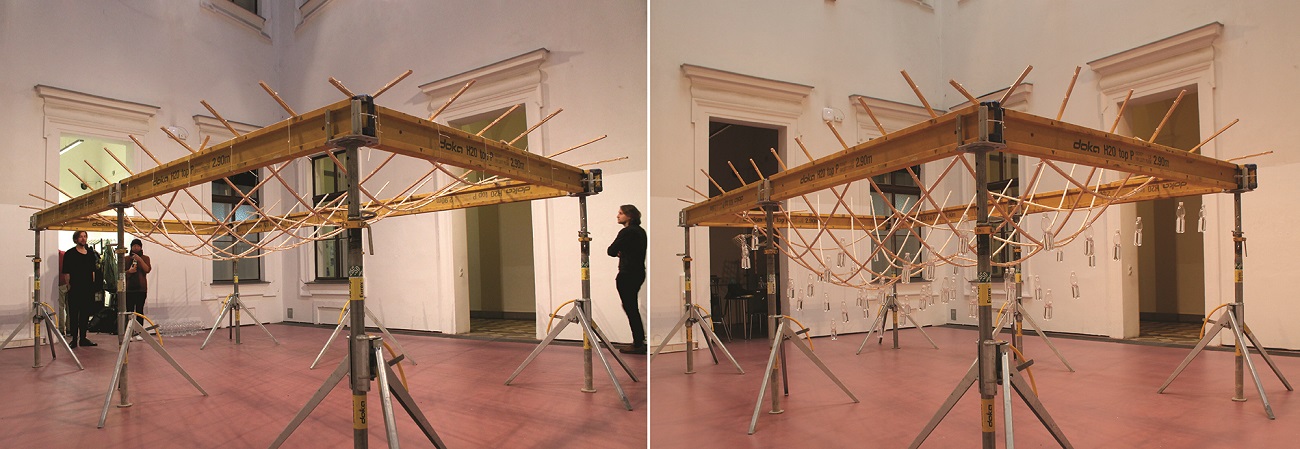
Digitally fabricated, layered, active-bending beams for the rapid assembly of temporary structures [pics]
The construction industry has not exploited the full potential of the new technologies that the digital era offers. Thus, construction remains a labour intensive task. Focusing on transportable, temporary structures, such as tents, an efficient construction method is active-bending.
Introduction
This method exploits the elastic bending of thin elements in order to create curved forms. Nevertheless, the bigger the desired curvature, the smaller the cross-sectional height should be. This results to lower stiffness of the final structure due to the slenderness of its parts. In order to solve this problematic, research has been conducted on hybrid active bending structures.
In the latter structures, additional elements, such as membranes and cables, are combined with the bending elements in order to stabilize them and increase their stiffness. This technique has been proven possible for up to 30 m span structures.
However, the installation process can become complicated since an equilibrium of forces needs to be achieved. Besides that, the structural calculations of the aforementioned systems can be intricate.
Given the above, the presented research proposes an alternative construction system for temporary structures based on active-bending. The aim of this research is to create a system that facilitates the erection and the reusability of temporary structures.
Research
The proposed system is a multi-layered beam which is flexible when it is flat, and thus susceptible to deformations, and stiff when it is bent on a predefined curvature. The flexibility relies on the relative slip between the layers, while the final increased stiffness relies on the constraining of the slip.
This simple principle has been materialized by introducing gaps between the joinery details of two consecutive layers. By differentiating the gap lengths, the curvature of the final stiff curvature can be controlled.
One locking point per beam, where all the layers are fixed, is required in order to facilitate the slip towards the correct direction. From the above becomes apparent that the more the layers of the beam the stiffer the final bent shape becomes.
Thus, scalable linear elements can be constructed flat and easily assembled in a curved configuration. By removing the boundary conditions, the element returns to its flat configuration. The reversibility of the elements allows for applications in temporary gridshell structures. (Fig. 0)
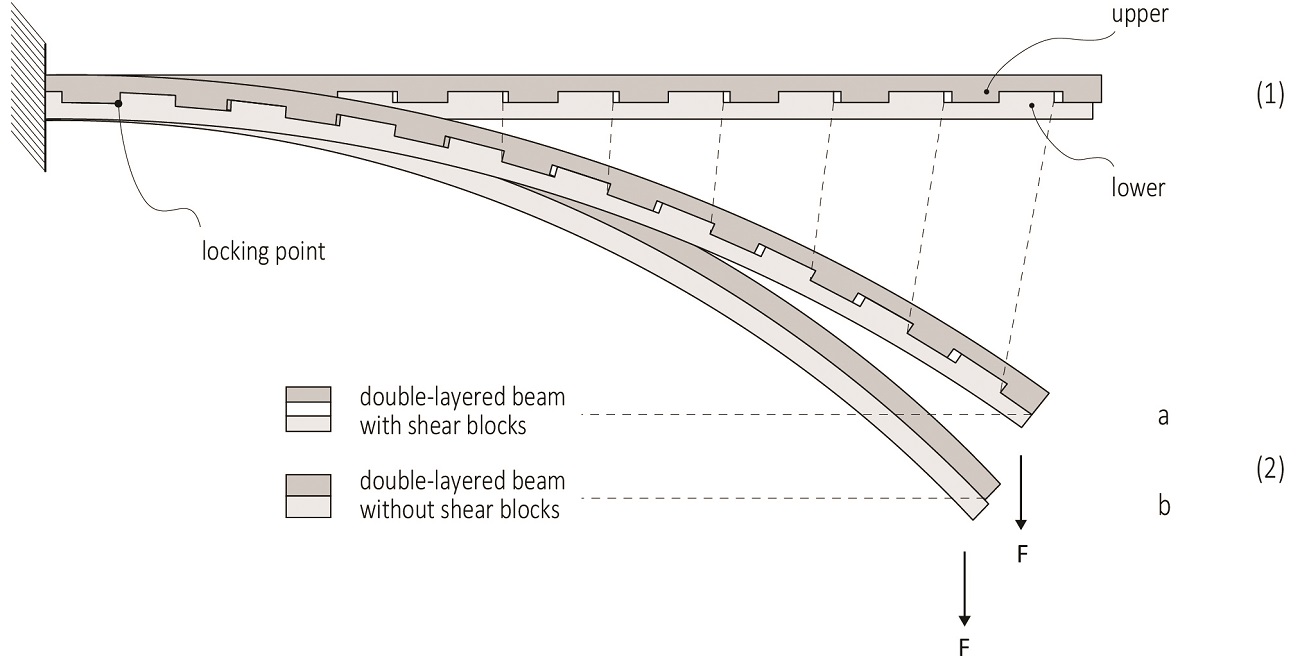
Fig. 0: Cantilevering variable stiffness linear element: 1) Flat and flexible state without forces, 2) Deformed and stiff state induced by force F, © NOUMENA design.research.education
The behaviour and the functionality of the system depend on the joinery detail between the consecutive layers. In this paper, two main geometries will be presented: a) the zig-zag and b) the rectangular.
The zig-zag detail allows controlled bending in one direction and unconstrained bending in the other direction. On the contrary, the rectangular detail, allows controlled bending in one direction and constrains bending in the other direction.
Variations of these two types can lead to structural optimization of the detail, such as rounding corners and increased contact area. Moreover, the distribution pattern of the joinery detail along the element can increase the structural performance, optimizing the fabrication time. (Fig. 1)
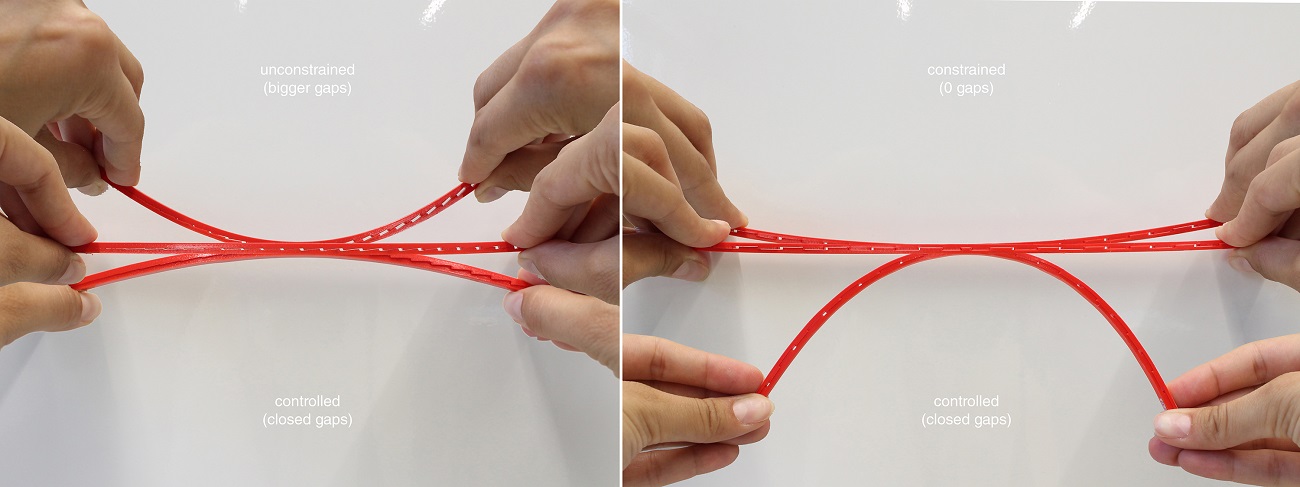
Fig. 1: Bending behavior of linear element with zig-zag (left) and rectangular joinery details (right), © NOUMENA design.research.education
Current research proves that fibre composites, as well as metals, are the most appropriate materials for bending active structures. Wood, as a natural fibre composite, has been chosen for this research as a low-cost solution with sufficient structural performance.
Various tests and prototypes, with various cross sections, have been conducted to prove the functionality and scalability of the proposed system. For the fabrication of the aforementioned prototypes, CNC milling with two different machines have been explored: a) a Kuka robot for the small cross sections (15×20 mm), and b) a Hundegger K3 for the larger cross sections (40×60 mm).
The fabrication with the Kuka robot allows the machining complicated details. For the tests of this research, a milling bit of 6 mm diameter was used to mill laths mounted on a wall. This resulted in filleted corners for the zig-zag specimens where the laths were milled from the sides.
However, sharp corners were achieved at the rectangular specimens where the laths were milled from the top.
A further limitation for the specific fabrication setup was the maximum length of milling which equals the radius of the robot (approximately 3 m). It has been noticed that the quality of the milling depends on the cantilevering of the robotic arm. (Fig. 2)
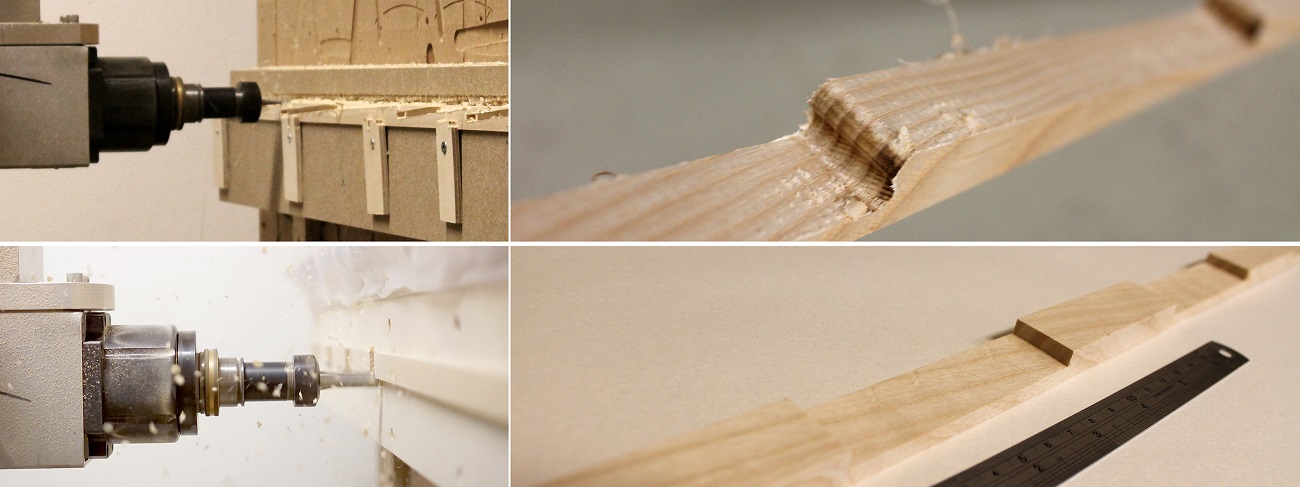
Fig. 2: Fabrication with Kuka robot. Top: zig-zag detail; Bottom: Rectangular detail (University of Applied Arts Vienna), © NOUMENA design.research.education
The fabrication with the Hundegger K3 was challenging and aimed to prove the potential of the mass production of the proposed system. The beams with the zig-zag detail were initially milled from the bottom. Their production process was problematic and resulted in breakages when the beam was cantilevering inside the machine.
In order to reduce the vibrations, two beams were milled simultaneously from both sides of one bigger beam. The latter beam was subsequently sliced in two pieces with an electric saw.
The incompetence of the K3 to clamp the zig-zag beam resulted in bad finishing and inaccuracies. However, the beams with the rectangular joinery detail were produced smoothly with a good finishing. (Fig. 3)
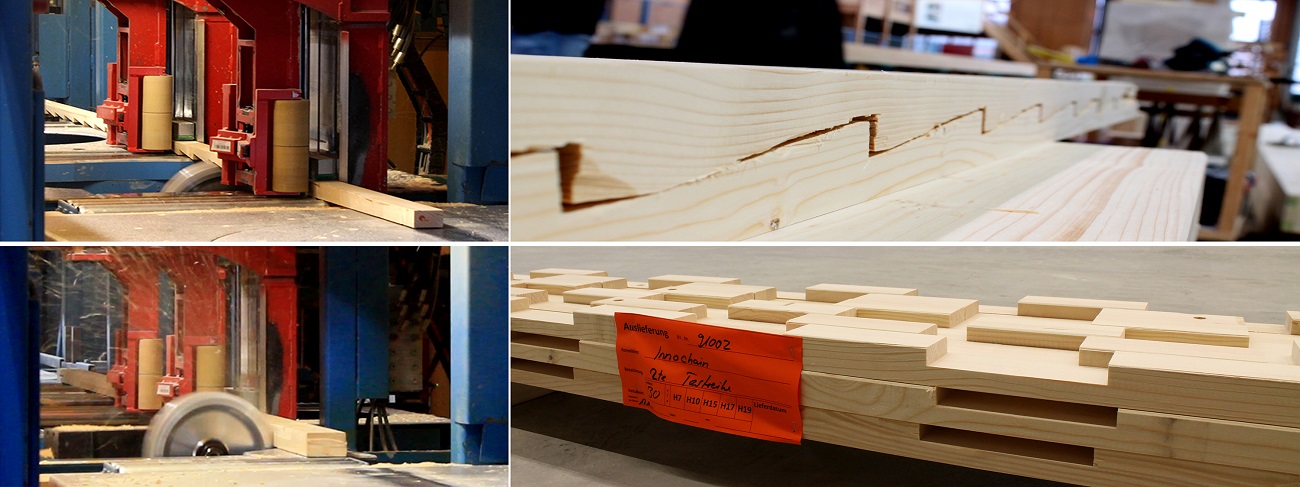
Fig. 3: Fabrication with Hundegger K3. Top: zig-zag detail; Bottom: Rectangular detail (Blumer Lehmann AG, Switzerland), © NOUMENA design.research.education
Two gridshell prototypes, produced with the aforementioned fabrication techniques, have been conducted; one simply supported and one cantilevering. Both prototypes have been fabricated from flat elements with equal cross sections and have been shaped into double-curved surfaces by uniform gravitational loads. (Fig. 4,5,6,7)
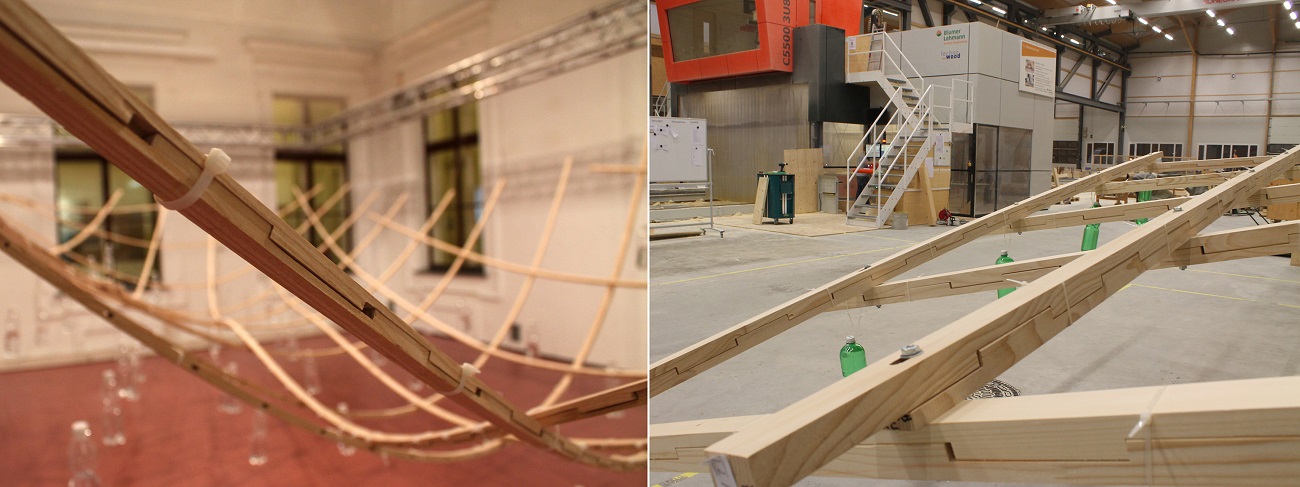
Fig. 4: Gridshells formed by gravitational loads. Left: Simply supported; Right: Cantilevering, © NOUMENA design.research.education

Fig. 5: Cantilevering gridshell of Left: Perspective view showing a shape-adaptable roof that is stored flat and self-organized in a free form shape, Right: Plan view with numbered elements, © NOUMENA design.research.education
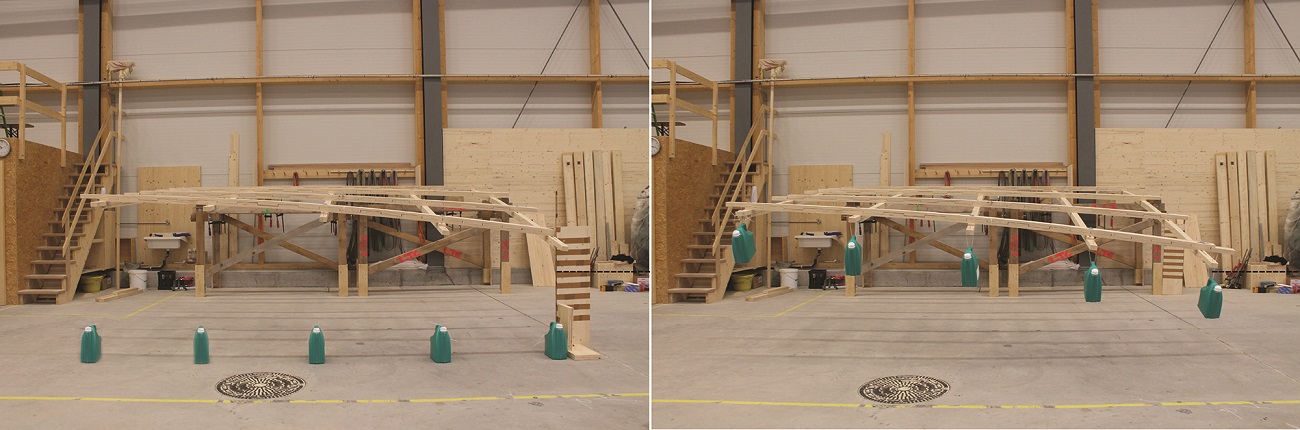
Fig. 6: Cantilevering gridshell. Left: Dead loads, Right: Gravitational loads at all cantilevering tips, © NOUMENA design.research.education
Conclusion
In conclusion, the proposed multi-layered beam allows the creation of bending-active structures with controlled stiffness, without limiting the maximum curvature and without the addition of external elements.
The behaviour of the system depends exclusively on the geometrical configurations of the joinery details and the material properties. Thus, curved beams can be easily erected from flat elements, since the construction manual is embedded in the joinery details.
Two CNC milling process have been used for the digital fabrication of wooden laths and obtained accuracy of the scale of a millimetre.
The gridshell prototypes proved the controlled deformation of the double-layered active-bending elements, as well as the scalability of the system.
Further steps of the research include the realization of a temporary larger scale gridshell structure which consists of industrially fabricated elements.
Article by Efilena Baseta / CO-Founding Partner of NOUMENA design.research.education
efilena@noumena.io
All photos and plans provided by NOUMENA design.research.education